Frankfinn Institute Franchise Cost 2026 — Fees, ROI & Honest Investor Review
Last updated: October 2026 | Reading time: 14 minutes
If you’ve been searching for “Frankfinn franchise cost” or “Frankfinn Institute fees,” you already know one thing — this brand is everywhere in India’s aviation and hospitality training sector. With 350+ centres across the country and over 1.3 million trained students, Frankfinn isn’t a newcomer chasing hype. It’s the category leader in aviation and hospitality training.
But category leader doesn’t automatically mean franchise gold. Before you write a cheque for ₹30–50 Lakhs, you deserve a detailed, honest breakdown of what you’re actually buying — the real costs, the royalty math, the ROI timeline, the support structure, and — most importantly — the honest risks no franchise marketing material will tell you about.
This guide does exactly that.
What is Frankfinn Institute of Air Hostess Training?
Frankfinn Institute of Air Hostess Training is India’s No. 1 rated aviation, hospitality, travel and customer service training institute, according to ASSOCHAM and multiple industry surveys. Founded in 1993, it has trained over 1.3 million students across more than 350+ centres in India and abroad — in countries including the UAE, UK, and Singapore.
The brand offers four core course tracks:
– Air Hostess & Cabin Crew Training (flagship — most popular)
– Hotel Management
– Travel, Tourism & Ticketing
– Customer Service & Personality Development
Their target student profile: a 10+2 pass student, typically between 17–24 years, aspiring to enter the aviation, hospitality, or customer service sector. The primary draw is Frankfinn’s placement assistance program — the institute claims active tie-ups with 250+ recruiters including IndiGo, Air India, SpiceJet, Taj Hotels, Marriott, OYO, and Thomas Cook.
Why the Brand Has Franchise Appeal
For a franchise investor, Frankfinn makes intuitive sense for three structural reasons:
- India’s aviation sector is expanding — with 60+ airports operational and 35 new airports planned by 2030, demand for trained cabin crew and ground staff is structurally growing
- Premium course fees = high per-student revenue — at ₹70,000–₹1,10,000 per student per year, the unit economics are strong
- Brand recognition drives walk-in admissions — students and parents in Tier 2 cities already know Frankfinn, dramatically reducing your marketing spend
But here’s the honest reality: strong brand does not automatically mean guaranteed profit. The location, city demographics, royalty structure, and your involvement in management all matter enormously.
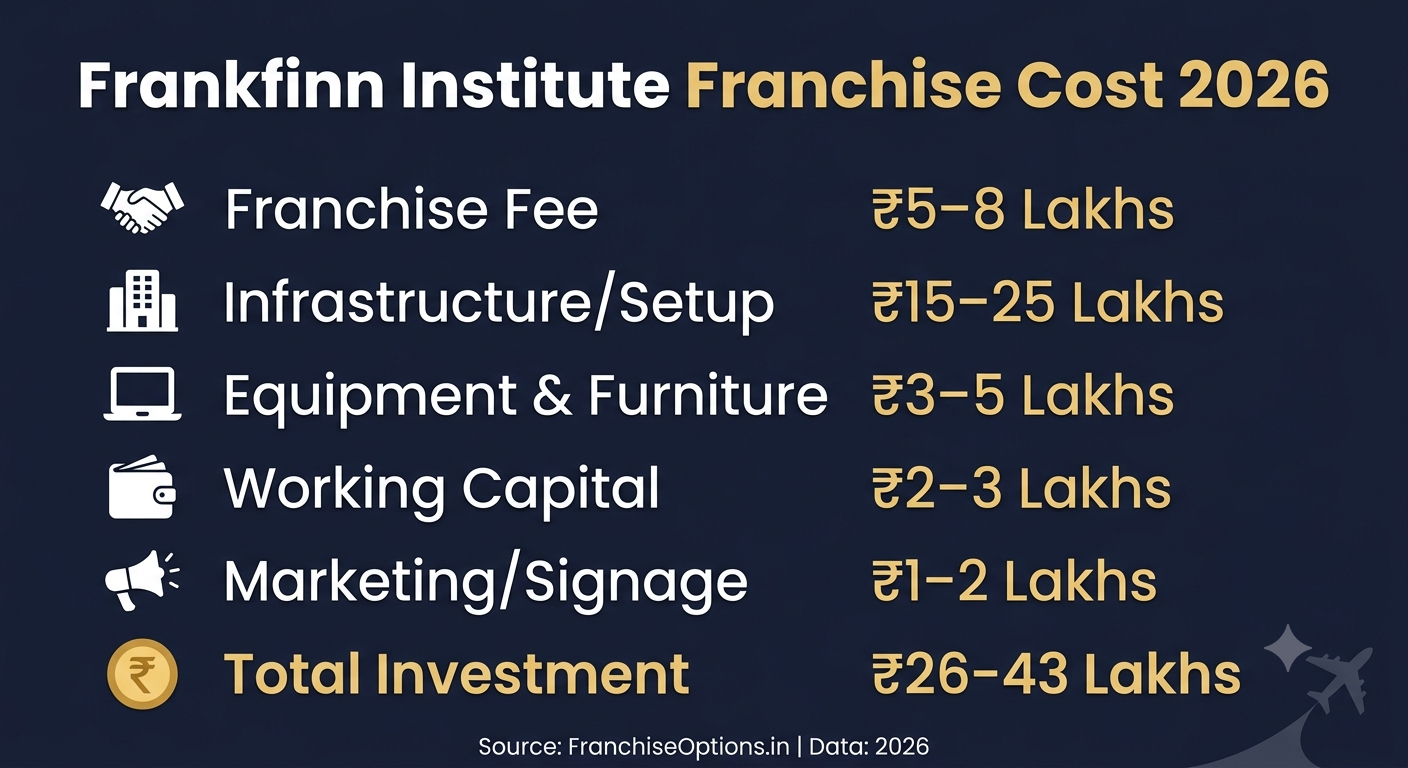
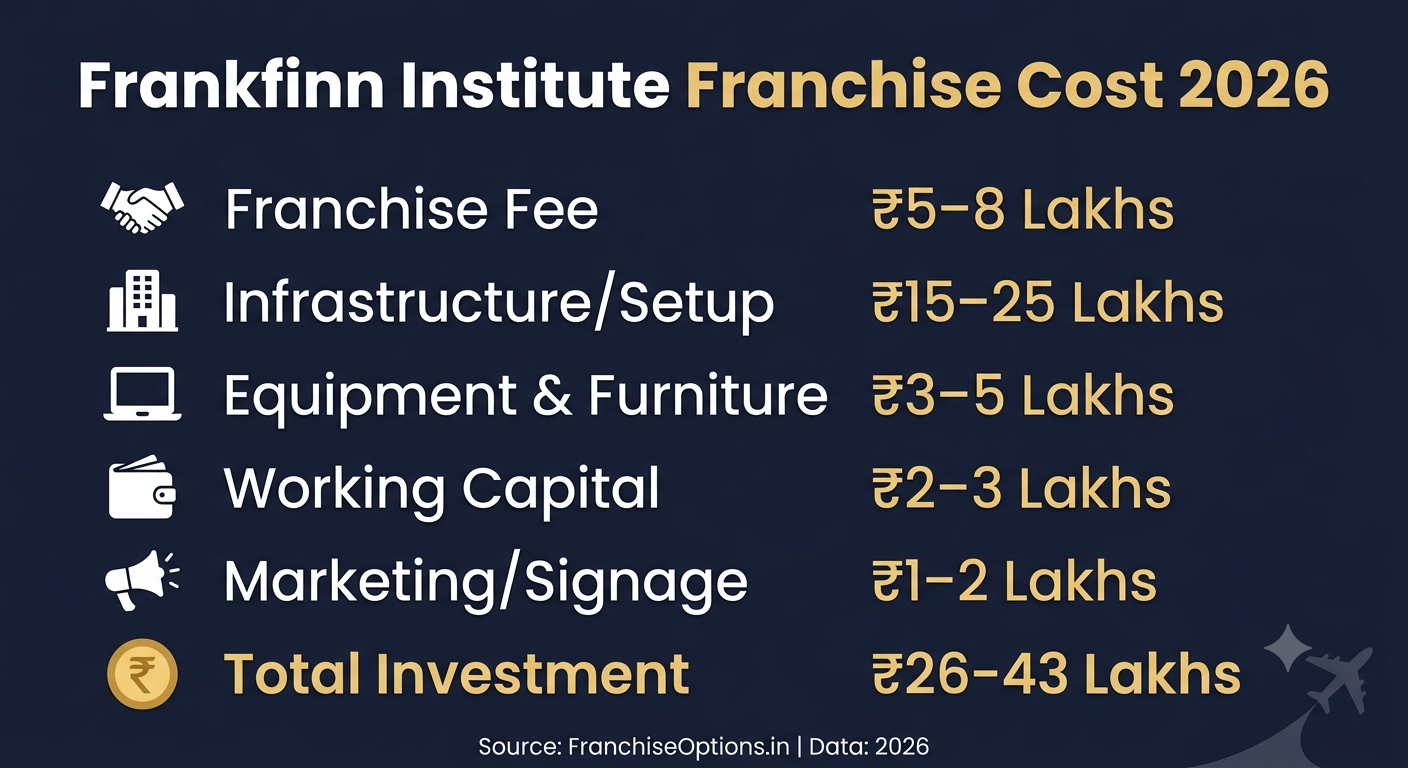
Frankfinn Institute Franchise Cost 2026 — The Complete Breakdown
Investment Breakdown Table — All Cost Components
| Cost Component | Amount (INR) | Notes |
|---|---|---|
| Franchise Fee (one-time) | ₹5 – 8 Lakhs | Paid to Frankfinn HQ on agreement signing |
| Centre Setup and Renovation | ₹15 – 25 Lakhs | Flooring, partitions, painting, AC, electrical |
| Equipment and Furniture | ₹3 – 5 Lakhs | Computers, projectors, desks, chairs, reception counter |
| Initial Marketing and Signage | ₹1 – 2 Lakhs | Frankfinn-approved hoardings, local digital ads, print |
| Working Capital (3 months) | ₹2 – 3 Lakhs | Staff salaries, rent buffer, admin expenses |
| Security Deposit (space rental) | ₹1 – 3 Lakhs | Varies by city and landlord |
| Miscellaneous and Contingency | ₹0.5 – 1 Lakh | Unexpected expenses during setup |
| Total Estimated Investment | ₹27.5 – 47 Lakhs | Tier 1 cities at higher end; Tier 2–3 at lower end |
Important: These figures are indicative estimates based on publicly available information and franchisee accounts shared in the public domain. The official Franchise Disclosure Document (FDD) from Frankfinn will have the exact, contractually bound numbers. Always request and review the FDD before signing anything.
Space Requirements
| Parameter | Minimum Requirement | Preferred |
|---|---|---|
| Total Area | 1,500 sq. ft. | 2,000–2,500 sq. ft. |
| Location | Ground or first floor | Ground floor, high-street visibility |
| Classroom Count | 2 classrooms | 3 classrooms for higher capacity |
| Reception Area | Mandatory | Minimum 100 sq. ft. |
| Faculty/Staff Room | Mandatory | With lockable storage |
| Restrooms | Mandatory (separate for students/staff) | — |
| City Tier Suitability | All tiers (1, 2, 3) | Tier 2 cities offer best ROI balance |
Ongoing Fee Structure (Royalty and Contributions)
| Fee Type | Rate | Frequency |
|---|---|---|
| Royalty | 15–20% of gross monthly revenue | Monthly |
| Marketing Fund Contribution | 2–3% of gross monthly revenue | Monthly |
| Annual Renewal Fee | ₹25,000 – ₹50,000 (estimated) | Annual |
| Training Refresh Fee | Minimal (part of agreement) | As scheduled |
The royalty rate of 15–20% is one of Frankfinn’s most debated aspects among franchisees. At 120 students per year earning ₹85,000 each, that is ₹10.2 Lakhs per year going back to Frankfinn HQ in royalty alone. Factor this into your break-even calculations carefully.
Frankfinn Course Fee Structure — Understanding Your Revenue Engine
As a franchisee, you earn revenue from student admissions. So understanding what students pay — and which courses they prefer — is critical to your financial planning.
| Course | Duration | Estimated Fee (2026) |
|---|---|---|
| Air Hostess and Cabin Crew Training (Diploma) | 12 Months | ₹70,000 – ₹1,10,000 |
| Hotel Management (Diploma) | 12 Months | ₹65,000 – ₹90,000 |
| Travel, Tourism and Ticketing | 6 Months | ₹45,000 – ₹65,000 |
| Customer Service and Personality Development | 3–6 Months | ₹25,000 – ₹40,000 |
Key revenue insight: The flagship Air Hostess Diploma is the highest-demand and highest-fee course. In most Frankfinn centres, 60–70% of students enrol for this course. A centre with 2 classrooms and a standard batch size of 25–30 students can accommodate 3–4 batches annually — that is 75–120 students per year from the Air Hostess program alone.
Admission Seasonality
Student admissions are not evenly distributed across the year. Peak admission months are:
– April to June — post Board exams, students seek professional courses
– October to December — second admission cycle
– January to February — lean period, requires active marketing
Plan your cash flow accordingly — rent and staff salaries are fixed monthly costs even in lean months.
ROI Calculator — Can You Actually Make Money with a Frankfinn Franchise?
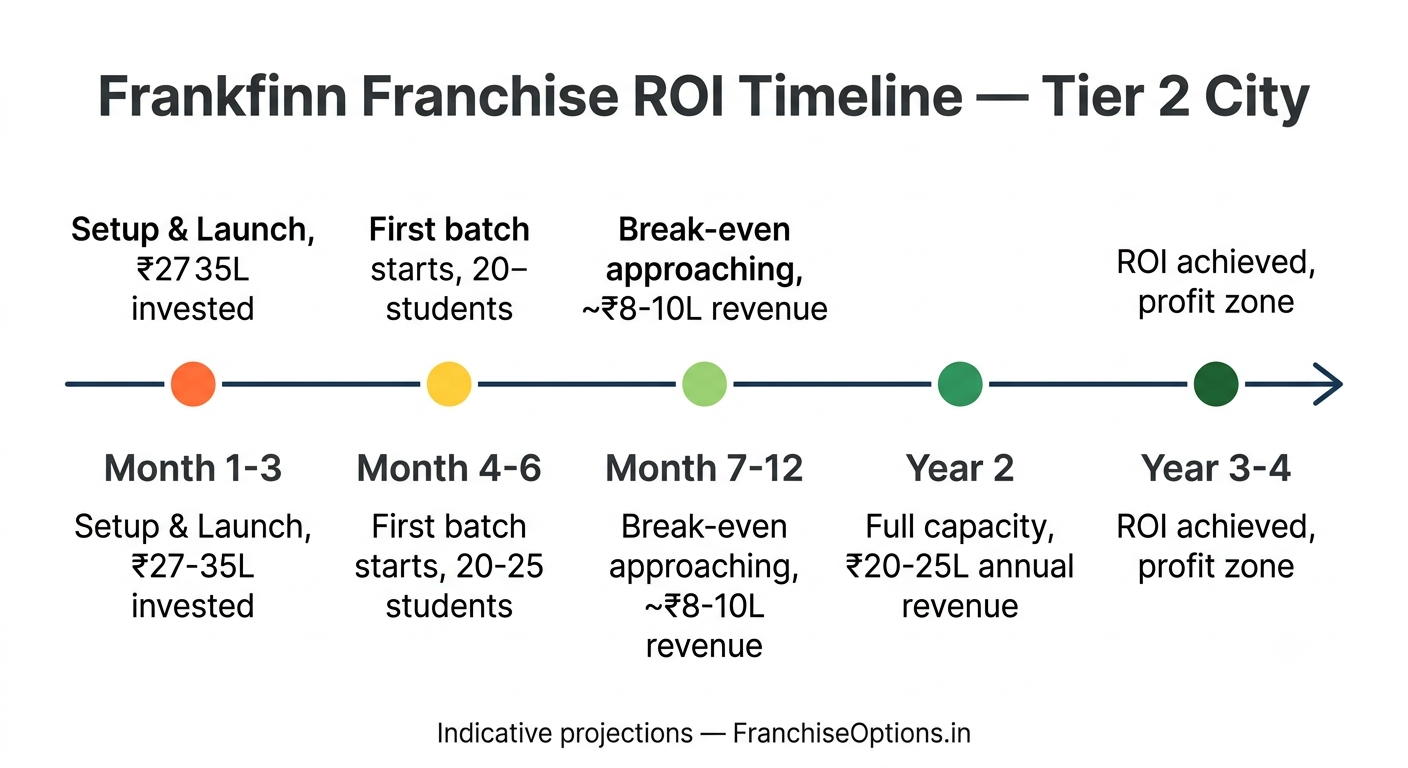
Revenue Projection Model
Scenario: Tier 2 City Centre (Conservative Estimate)
| Year | Students Enrolled | Avg. Fee | Gross Revenue | Royalty (18%) | Operating Costs | Net Profit |
|---|---|---|---|---|---|---|
| Year 1 | 60–80 | ₹75,000 | ₹45–60L | ₹8.1–10.8L | ₹25–30L | ₹7–19L |
| Year 2 | 90–120 | ₹80,000 | ₹72–96L | ₹13–17.3L | ₹27–32L | ₹22–47L |
| Year 3 | 120–150 | ₹85,000 | ₹1.02–1.27Cr | ₹18.4–22.9L | ₹28–33L | ₹40–71L |
Operating costs include: Rent ₹40,000–₹70,000 per month, Staff salaries ₹60,000–₹90,000 per month for 3–4 staff, utilities, local marketing, consumables.
Break-Even Analysis
| City Type | Investment | Annual Profit (Yr 2) | Break-Even |
|---|---|---|---|
| Tier 2 city | ₹30–38L | ₹22–35L | 12–20 months |
| Tier 1 city | ₹40–47L | ₹28–45L | 12–18 months |
| Tier 3 city | ₹28–33L | ₹12–22L | 18–30 months |
Reality check: These projections assume good location, active admission cycle management, and a franchisee who is hands-on in Year 1. A passive investor leaving operations entirely to a manager will likely see 25–40% lower numbers.
Who Should Apply for a Frankfinn Franchise?
Ideal Franchisee Profile
- Capital ready: ₹30–50 Lakhs investable (including 20% contingency buffer)
- Background fit: Education administration, HR, training, or people management experience
- City advantage: Located in a Tier 2 or Tier 3 city with an active 18–25 age demographic
- Time commitment: Ready to dedicate significant personal involvement in Year 1. This is NOT a sit-back-and-collect model in the early stages
- Market insight: City has limited quality aviation/hospitality training competition. Large cities like Delhi and Mumbai are saturated
- Infrastructure: Can secure 1,500–2,500 sq ft ground floor or high-street property at reasonable rent
Not a Good Fit If You:
- Expect to stay fully passive — hired managers running a training centre without owner oversight almost always underperform
- Are in a very small town with a population below 3 Lakhs and limited college-going youth
- Expect break-even within 12 months — the admission cycle means the first full year of revenue comes in batches, not immediately
- Cannot manage negative cash flow for the first 3–6 months post-launch while the first batch is enrolled
Frankfinn Franchise Application Process — Step by Step
- Reach out to Frankfinn’s Franchise Development Team via their official website Partners section, or directly email their regional office
- Initial discussion — a Frankfinn representative will call to discuss your city, location preference, and investment capacity
- Receive the Franchise Information Memorandum (FIM) — a preliminary overview document, not the full FDD
- Location survey — Frankfinn’s team physically visits your proposed location and evaluates suitability
- Franchise Disclosure Document (FDD) issued — read this carefully with a lawyer. This contains royalty terms, territory clause, exit terms, and your obligations
- Agreement signing — typically a 3–5 year initial agreement with renewal rights
- Fee payment — franchise fee plus security deposit paid
- Pre-launch training — you and your key staff attend a 2–4 week orientation program at Frankfinn’s regional or national HQ
- Centre setup — renovation, equipment, signage done under Frankfinn’s brand guidelines
- Soft launch — first batch enrollment begins, typically within 60–90 days of agreement signing
Realistic total timeline from first contact to first student enrolled: 4–6 months
What Support Does Frankfinn Provide?
| Support Category | What You Get | What You’re Responsible For |
|---|---|---|
| Curriculum and Content | Complete course material, updated annually | Delivering classes — you need qualified trainers |
| Faculty Training | Initial plus periodic refresher training at HQ | Day-to-day faculty management is yours |
| Placement Assistance | Access to 250+ recruiter network | Following up with specific companies for your batch |
| National Marketing | TV, digital, and social media brand campaigns | Local area marketing (hoardings, college visits, digital) |
| Software and ERP | Admissions management, fee collection, attendance | Data entry and daily operations |
| Quality Audit | Quarterly centre visits and audits | Maintaining standards daily without reminders |
| Brand Materials | Brochures, banners, uniform specs | Printing, procurement, distribution |
Key takeaway: Frankfinn provides the brand, content, and national reach. You provide the local execution. Don’t expect Frankfinn HQ to fill your classrooms. That is your job.
Frankfinn Franchise — Honest Pros and Cons
Genuine Advantages
- India’s strongest brand in aviation training — the Frankfinn name opens doors with students and parents in Tier 2–3 cities where brand trust matters enormously
- Proven placement track record — documented recruiter tie-ups make closing admissions significantly easier. Parents pay ₹80,000+ because they trust the placement outcomes
- Standardised curriculum — you don’t need to build a course from scratch; Frankfinn’s curriculum is ready-made, updated, and battle-tested
- Structural demand growth — India’s aviation sector is expanding; demand for cabin crew training isn’t going away
- Recurring annual batches — once established, admission cycles repeat predictably; Year 3 onwards is relatively stable income
Genuine Risks
- High royalty (15–20%) is the single biggest margin compressor — on a ₹1 Crore gross revenue centre, you’re sending ₹15–20L back to Frankfinn every year
- Location is everything — a wrong location choice, even 2 km from ideal, can permanently cap your enrolment. Frankfinn won’t relocate your centre for free
- Online competition is real — post-COVID, several online aviation training platforms launched at 50–70% lower fee points. They don’t offer placement at the same level, but cost-sensitive students notice
- Dependence on placement outcomes — if IndiGo or Air India slows hiring (as happened during COVID), your next admission cycle suffers, even though your fixed costs don’t
- Tier 1 city saturation — in Delhi, Mumbai, Bengaluru, Hyderabad, Chennai, Frankfinn already has multiple centres. Getting a territory in these cities is increasingly difficult
Frankfinn vs. Competitors — Franchise Investment Comparison
| Brand | Investment Range | Royalty | Brand Recognition | Best City Type |
|---|---|---|---|---|
| Frankfinn Institute | ₹27–47L | 15–20% | 5 out of 5 | Tier 2–3 |
| Aptech Aviation | ₹20–35L | 12–15% | 4 out of 5 | Tier 1–2 |
| IATA Training Centre | ₹15–25L | 10–12% | 4 out of 5 | Metro |
| Air Hostess Academy | ₹10–20L | 8–12% | 3 out of 5 | Regional |
| Capt. Sunjoy Aviation | ₹8–15L | 10–15% | 2 out of 5 | Tier 2–3 |
| Independent Institute | ₹5–15L | 0% | 1 out of 5 | Depends on founder |
For brand power in aviation training, Frankfinn remains unmatched — but you pay for that brand through royalties. For investors where margin efficiency is the priority, Aptech Aviation or IATA Training offer a lower-cost entry point at the cost of fewer walk-in admissions in Tier 2 markets.
Cities Where Frankfinn Franchises Are Currently in Demand (2026)
High Potential — Likely Available
- Tier 2 growth cities: Indore, Vadodara, Bhubaneswar, Coimbatore, Mysuru, Rajkot, Jodhpur, Nashik, Udaipur, Vijayawada
- Northeast expansion: Guwahati, Shillong, Dibrugarh, Dimapur, Aizawl
- Smaller metros: Patna, Ranchi, Raipur, Agartala, Imphal
Likely Saturated — Check Carefully Before Applying
- Delhi NCR, Mumbai, Pune, Bengaluru, Hyderabad, Chennai, Kolkata, Ahmedabad, Jaipur
Note: Saturated doesn’t mean impossible — it means Frankfinn likely already has 2–4 centres in these cities and a new centre would be competing for the same student pool. If you’re in one of these cities, ask Frankfinn specifically about the minimum distance between franchisees in your area.
6 Non-Negotiable Questions to Ask Frankfinn Before Signing
-
What is my exact territory, and is it geographically defined in the agreement? Vague territory clauses allow Frankfinn to open another centre 5 km away.
-
Can I speak with 3 existing franchisees in cities similar to mine? Any brand that refuses this request is hiding something. Existing franchisees are your best source of unfiltered truth.
-
What happens if my enrolment falls below the minimum threshold in Year 1? Is there a grace period? Do you face penalty or risk agreement termination? Read this clause very carefully.
-
What is the exact exit clause if I want to close or sell the franchise in Year 2? Some franchise agreements lock you in with heavy exit penalties of ₹5–15L. Know this before you sign.
-
Is placement assistance contractually guaranteed, or is it best-effort? If it’s best-effort and placements slow cyclically, your next admission cycle suffers. Know the difference in writing.
-
What technology and ERP systems do I get access to, and what are the additional costs? Software licensing fees are sometimes not disclosed upfront and can add ₹50,000–₹1.5L annually to your cost structure.
Verdict — Should You Invest in a Frankfinn Franchise in 2026?
Yes — with the right city, location, and mindset.
Frankfinn is not a passive investment. It is a brand-powered education business that requires the right location in a Tier 2–3 city with a college-going population, a hands-on owner at least in Year 1, financial runway for 6–9 months before full cash flow stabilises, and a clear-eyed view of the royalty structure and its impact on margins.
If these conditions are met, Frankfinn offers a credible path to a ₹25–60 Lakhs per year profit business by Year 2–3. The brand recognition is genuine and matters enormously in India’s semi-urban markets. The placement network, curriculum, and national marketing give you a head start that an independent institute would take 5–7 years to build.
The 15–20% royalty is the price you pay for all of that — and for most well-located Tier 2 franchisees, it’s a price worth paying.
For lower-investment alternatives in education franchising, explore more options at [INTERNAL LINK: /franchise-listing/?category=education] or check out the [INTERNAL LINK: /low-investment-franchise-india/] guide.
FAQ — Frankfinn Institute Franchise 2026
Q1: What is the total investment required to open a Frankfinn franchise in 2026?
The total investment for a Frankfinn Institute franchise ranges from approximately ₹27 Lakhs to ₹47 Lakhs, depending on city tier and location. This includes the one-time franchise fee of ₹5–8 Lakhs, centre setup and renovation of ₹15–25 Lakhs, equipment and furniture of ₹3–5 Lakhs, initial marketing and signage of ₹1–2 Lakhs, working capital of ₹2–3 Lakhs, and a security deposit for the space of ₹1–3 Lakhs. Tier 1 city centres typically cost more due to higher real estate and renovation costs.
Q2: How much can I earn from a Frankfinn franchise per year?
A well-managed Tier 2 city Frankfinn centre enrolling 90–120 students per year from Year 2 onwards can generate ₹72–96 Lakhs in gross revenue. After paying royalties at 18%, operating costs including rent, salaries, and marketing, net profit typically ranges from ₹22–47 Lakhs in Year 2. Year 3 profits can reach ₹40–70 Lakhs as the centre reaches full capacity.
Q3: What is Frankfinn’s royalty percentage and is it negotiable?
Frankfinn charges approximately 15–20% of gross monthly revenue as royalty, plus a 2–3% marketing fund contribution. This is non-negotiable for standard franchisees. The royalty rate is one of the higher ones in the education franchise sector. Always factor this into your financial projections — at ₹1 Crore gross, you pay ₹17–23 Lakhs back annually in royalties and marketing contributions.
Q4: How long does it take to break even on a Frankfinn franchise investment?
For most franchisees in Tier 2–3 cities, break-even falls between 12–24 months, assuming active management, good location, and consistent enrolment of 60–80 students in Year 1 ramping to 100–120 in Year 2. Tier 1 city centres with higher investment but also higher fee-paying students can break even slightly faster if enrolment is strong.
Q5: Do I need a background in education to open a Frankfinn franchise?
No formal education background is required. However, candidates with experience in education administration, HR, training, counselling, or general business management tend to perform significantly better. Frankfinn provides the curriculum, but you manage admissions, student experience, and day-to-day operations. People skills and management ability are essential.
Q6: Is Frankfinn franchise available in my city?
Frankfinn actively seeks franchisees in Tier 2 and Tier 3 cities across India. Tier 1 metros like Delhi, Mumbai, Bengaluru, Hyderabad, and Chennai may be saturated with existing centres. The best way to check availability in your city is to contact Frankfinn’s franchise development team directly through their official website.
Q7: What happens to my investment if Frankfinn shuts down or exits my region?
This risk is real for any franchise investment. The franchise agreement should specify what happens to the franchise fee and setup investment in such a scenario. Read the exit and termination clauses very carefully with a franchise lawyer before signing. Established brands like Frankfinn with 30+ years in operation represent lower exit risk than newer brands, but no franchise is entirely risk-free.
Disclaimer: All investment figures, royalty rates, and revenue projections mentioned in this article are indicative estimates based on publicly available information, industry reports, and franchisee accounts shared in the public domain. Actual figures may differ significantly based on individual agreements, city-specific factors, and franchisor policies at the time of agreement. FranchiseOptions.in is an independent information platform and does not represent, partner with, or have any financial relationship with Frankfinn Institute. Always request and carefully review the official Franchise Disclosure Document (FDD) from Frankfinn Institute before making any financial commitment.